Few gemstones on Earth command such fascination. The world’s most famous deep blue jewel combines beauty, royal drama, and scientific mystery. It also carries an infamous reputation for bad luck. Still, diament hope remains an enduring marvel. Centuries of gossip painted the stone as a bringer of ruin. Yet the verified history proves far richer than any Hollywood myth.
Today, the gemstone rests securely in the United States national collection. Before reaching its pedestal in Washington, D.C., it journeyed across continents. It changed shapes and disappeared during revolutions. It also served as the centerpiece of a legendary marketing campaign.
The Birth of a Legend: From the Kollur Mine to the French Royal Court
The story begins in seventeenth-century India. Miners discovered a rough blue crystal in the Kollur mine in Golconda. The stone weighed over 112 carats and displayed an uncommon violet-blue tone. In that era, blue diamonds were exceptionally rare anomalies. Its sheer size made it unprecedented.
French merchant Jean-Baptiste Tavernier bought the stone and took it to Paris. A popular myth claimed he stole it from a Hindu idol. The story warned that wild dogs killed him as punishment. Historical records contradict this tale. Tavernier actually lived past eighty, conducted trade, and died peacefully.
In 1668, Tavernier sold the large rough stone to King Louis XIV. The king ordered his court jeweler to recut the gem. The resulting 67-carat stone became known as the French Blue. Set in gold, it hung from a royal neck ribbon as a symbol of French power.
The French Revolution, the 1792 Heist, and a Secret Recut
King Louis XV later placed the royal jewel into a ceremonial badge. However, the French Revolution soon ended the monarchy. Revolutionaries seized the crown jewels and stored them at the Garde-Meuble. In September 1792, rioters looted the repository. The French Blue vanished into the night.
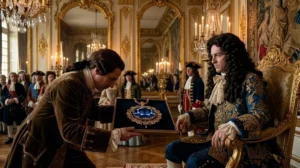
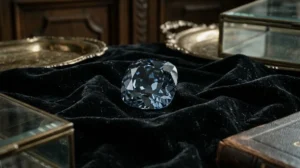
The thieves faced a massive challenge. The world recognized the royal diamond instantly. To hide its origins, the thieves smuggled the gem to London. A skilled lapidary recut the diamond down to 45.52 carats. This cushion design hid the original facets while saving maximum weight.
The jewel soon resurfaced in the collection of Henry Philip Hope. He was a wealthy banker and passionate collector. From this point on, diament hope carried the family name. After the banker died, his heirs fought bitter inheritance disputes. Financial troubles eventually forced them to sell the treasure to private dealers.
The Curse of the Hope Diamond: Myth vs. Pierre Cartier’s Sales Genius
Superstition claims the stone brings tragedy to every owner. Believers cite the executions of Louis XVI and Marie Antoinette. They also point to bankruptcies and family deaths. However, archival records show that writers exaggerated these rumors.
Around 1900, former actress May Yohe blamed the gemstone for her failed marriage. Tabloids eagerly printed her dramatic claims. Parisian jeweler Pierre Cartier saw a brilliant business opportunity. In 1910, he pitched the gem to American heiress Evalyn Walsh McLean. Cartier emphasized the supernatural curse because he knew she loved mysticism.
McLean bought the jewel and wore it with bold flair. She loved hosting lavish Washington parties while wearing it. The McLean family later suffered genuine personal tragedies. They lost their young son in an accident and faced deep financial distress. However, these events were tragic coincidences. Sensational newspapers simply weaponized them to keep the curse alive. Through all the media drama, diament hope remained a celebrated icon of luxury.
Geological Rarity and the Mystery of Red Phosphorescence
Beyond social intrigue, the physical structure makes this stone a natural anomaly. Gemologists classify it as a rare Type IIb diamond. Its carbon lattice contains almost no nitrogen. Instead, trace boron atoms permeate the structure. Boron absorbs red light, giving the stone its deep grayish-blue color.
The diamond formed hundreds of miles below Earth’s crust in the lower mantle. Because of this origin, diament hope exhibits a striking optical effect. Shortwave ultraviolet light makes the gem glow with vivid red phosphorescence. The crimson glow lingers for over a minute after switching off the UV lamp. Superstitious owners once viewed this eerie glow as proof of a dark curse.
Science finally verified the diamond’s royal origins in 2008. Mineralogist François Farges found an eighteenth-century lead model of the French Blue in Paris. Scientists scanned the cast with 3D lasers. Computer models proved that craftsmen carved the modern diament hope directly from the French Crown jewel.
Pop Culture and the Titanic Connection
The visual drama of this blue gemstone inspired iconic movie imagery. Most notably, it inspired the Heart of the Ocean in James Cameron’s 1997 film Titanic. The movie’s blue necklace closely mirrors the French Blue.
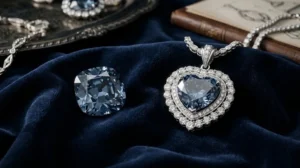
This cinematic tribute confused millions of viewers. Many wondered if the real diament hope sank into the North Atlantic. In truth, the diamond was never on the ship. When the Titanic sank in April 1912, Evalyn Walsh McLean kept the gem safely at home. Still, the film permanently tied the jewel to ocean lore.
Harry Winston’s $2.44 Postal Parcel and the Smithsonian Era
Evalyn Walsh McLean died in 1947, leaving massive estate debts. Renowned New York jeweler Harry Winston bought her collection in 1949. He toured the blue gem globally for ten years to raise money for charity. To jewelry lovers everywhere, diament hope represented the absolute peak of gemstone rarity.
In November 1958, Winston donated the stone to the Smithsonian Institution. He wanted to help build a premier national gem collection. Winston skipped armored trucks and private security guards. Instead, he placed the gem inside a plain cardboard box. He wrapped it in brown paper and shipped it via regular registered mail. The postage cost him just $2.44.
Since that delivery, diament hope has remained on display at the National Museum of Natural History. Millions of visitors admire it every year. It ranks as one of the most visited exhibits in the world, right alongside the Mona Lisa. Market analysts estimate its value around $350 million. However, the Smithsonian considers the cultural treasure completely priceless.
FAQs
What are the exact dimensions and carat weight of the diamond?
The gemstone weighs exactly 45.52 carats (about 9.1 grams). It features an antique cushion brilliant cut with a faceted girdle.
Why does the gemstone glow with a red hue under ultraviolet lamps?
Energy from UV light excites the trapped boron atoms within the crystal. As the diamond releases that energy, it emits visible red light.
Can private collectors purchase this gemstone today?
No. The jewel belongs to the American public. It remains a permanent part of the Smithsonian Institution’s National Gem Collection.
Did the gemstone ever harm anyone at the Smithsonian?
No. Museum records show zero evidence of harm or misfortune among staff or visitors. The stone sits quietly behind protective glass every day.
Centuries of exploration, high-stakes theft, and scientific discovery surround this jewel. Ultimately, diament hope proves that true history surpasses fiction. As an ancient mantle crystal that outlasted royal dynasties, diament hope stands as an enduring symbol of natural wonder and human craftsmanship.