Anxiety over ordering the wrong jewelry size is entirely natural. You spot the perfect band online, but you are immediately held back by a single, nagging question: Will it actually fit? Fortunately, learning how to measure ring size at home is much simpler than it seems, provided you understand the mechanics of a truly precise measurement.
The secret to avoiding the hassle of returns and resizing lies in taking the time to measure carefully before making a purchase. By following a few expert techniques, you can confidently determine your exact measurements from the comfort of your own bedroom.
Before You Measure: The 3 Rules of Finger Fluctuations
Before diving into the tools, you need to understand that your fingers are living, changing parts of your body. They fluctuate in size based on the environment, the clock, and your physical state.
1. Timing is Everything
Your fingers tend to be puffier first thing in the morning due to fluid retention, and they naturally expand as the day goes on. For the most dependable results, it is best to take your final measurements in the afternoon or evening when your hands are at their natural, average size.
2. Temperature Matters
Environmental temperature plays a major role in your hand anatomy. Fingers shrink when cold and swell significantly when exposed to hot weather, a warm shower, or intense exercise. Always ensure you are at a comfortable room temperature before attempting any DIY methods.
3. Identify Your Hand Bias
The fingers on your dominant hand are typically up to half a size larger due to muscle usage. Always measure the specific finger on the exact hand where you plan to wear the piece to ensure long-term comfort.
Method 1: The Paper Strip Method (Measuring Circumference)
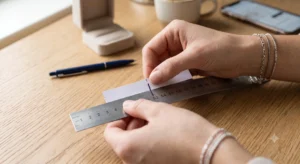
The paper strip approach is an excellent DIY option that relies on measuring the outer loop of your finger. It requires nothing more than a thin strip of paper, a pen, and a metric ruler.
When learning how to measure ring size at home with paper, precision is critical. Always make sure the paper is snug but comfortably able to slide over your skin. This technique determines your ring circumference, which is the total distance around your finger. Once you have your total length noted down, you can map the measuring paper strip in mm directly to a standard sizing guide.
Method 2: The Existing Ring Trick (Measuring Inner Diameter)
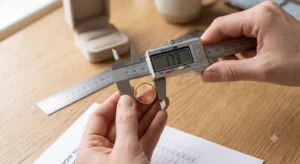
If you want to measure ring size without a ring on your physical hand, you can easily use a piece of jewelry that already fits you perfectly. This approach is highly reliable because it eliminates the risk of wrapping a flexible material too tightly or too loosely.
To pull this off, place your existing piece of jewelry flat against a hard surface. Take a metric ruler and position it directly across the center of the interior circle. You must measure straight across the inside edge on one side directly to the inside edge on the absolute opposite side.
Critical Note: Do not include the metal walls of the band itself in your final calculation. You want the inner diameter measurement only.
Once you determine the inside diameter mm with a ruler, you can use a conversion table to discover your match. Knowing how to measure ring size at home using an existing piece is incredibly helpful when shopping for everyday styles or delicate fine jewelry sizing.
Method 3: Download the 100% Scale Printable Ring Sizer
If you prefer a visual reference tool that mimics what a professional jeweler uses, downloading a printable ring sizer guide is the logical next step. Many top online jewelry brands offer a free printable ring sizer pdf that you can print out from your personal computer.
When using this method, the absolute most critical technical step is checking your printer settings. You must ensure that your page scaling is set to 100 percent or “none” in your printer dialog box. If your printer automatically shrinks the file to fit the page margins, the entire chart will be inaccurate, leading to a mismatched purchase.
Once printed, verify the accuracy of the sheet by placing a physical ruler against the printed scale indicator on the page. From there, you can carefully cut out the provided paper measuring tape slot, wrap it around your finger, and read the exact number indicated by the line.
Method 4: Request a Free Plastic Adjustable Ring Sizer
While DIY home hacks are convenient, nothing beats the security of using a dedicated, physical measuring tool. If you are preparing to buy an expensive heirloom or want absolute peace of mind, you should request a complimentary physical ring sizer tool from an online retailer.
Many dedicated jewelry sites will ship a plastic adjustable ring sizer directly to your home for free. This tool operates exactly like a miniature belt. You simply slip the loop onto your finger and pull the plastic strap until it feels snug but comfortable.
The biggest advantage of a plastic sizer belt is its reusability. It allows you to test the fit at different times of the day, helping you confirm that your chosen size remains comfortable whether you are relaxed on the couch or working at your desk.
The Band Width & Comfort-Fit Conversion Secret
A major reason why online orders fail is that shoppers assume a single size applies to every jewelry style. In reality, the physical shape and thickness of a band drastically change how it feels on your hand.
First, consider the structural difference between standard fit vs comfort fit ring sizing:
-
Standard Fit: The interior wall of the band is completely flat. This style sits flush against your skin and creates more surface friction.
-
Comfort Fit: The interior wall is slightly domed and curved. This creates less direct friction, making the jewelry slide on effortlessly. Because of this domed design, comfort fit styles often feel slightly looser.
Second, you must account for band width sizing variations. Thin, delicate bands slide over your skin with ease, but wider band styles act like a small sleeve, compressing more skin tissue. If you are purchasing a thick style, it is a smart rule of thumb to add an additional quarter or half size to your regular measurement to ensure it remains comfortable over long periods of wear.
The Large Knuckle Sizing Formula
If you have knuckles that are noticeably wider than the actual base of your finger, standard measuring tips will likely fail you. If you only measure the base, the finished product will get stuck at your knuckle and won’t slide on at all.
To apply this formula, use the paper strip method to find the millimeter circumference of the base of your finger, then repeat the exact same steps directly over the widest part of your knuckle. Add those two numbers together and divide the total by two. The resulting number gives you the perfect size, ensuring the band can pass over your knuckle with slight resistance while still sitting securely at the base without sliding around.
International Ring Size Conversion Chart
Because jewelry sizing metrics vary across global markets, it is vital to use an international ring size chart to verify your final coordinates. The United States uses a numbering index, the United Kingdom utilizes an alphabetical system, and Europe relies on direct millimeter circumferences.
The markdown table below allows you to quickly cross-reference your millimeter measurements against global standards.
| Inside Diameter (mm) | Inside Circumference (mm) | US Sizing | UK Sizing | European Sizing |
| 15.7 mm | 49.3 mm | Size 5 | J 1/2 | 49 |
| 16.0 mm | 50.3 mm | Size 5.5 | L | 50.5 |
| 16.5 mm | 51.8 mm | Size 6 | M | 52 |
| 16.9 mm | 53.1 mm | Size 6.5 | N | 53 |
| 17.3 mm | 54.4 mm | Size 7 | O | 54.5 |
| 17.7 mm | 55.7 mm | Size 7.5 | P | 55.5 |
| 18.1 mm | 56.9 mm | Size 8 | Q | 57 |
| 18.5 mm | 58.2 mm | Size 8.5 | Q 1/2 | 58 |
| 19.0 mm | 59.7 mm | Size 9 | R 1/2 | 59.5 |
FAQs
What should I do if I find myself between two ring sizes?
If your final metric numbers fall squarely between two options on a standard chart, the safest option is to size up rather than down. A band that is slightly loose is far more comfortable and safer to wear daily than one that pinches your skin or restricts blood circulation.
Can all styles of rings be resized later by a jeweler?
Traditional precious metals like gold, platinum, and silver are highly malleable and can easily be adjusted up or down by an experienced jeweler. However, alternative modern metals such as tungsten, titanium, and ceramic are incredibly hard and impossible to alter. Additionally, eternity designs with diamonds set around the entire perimeter cannot be modified without destroying the setting.
How tight should a ring fit under normal conditions?
A properly fitting band should slide over your knuckle with a tiny bit of resistance but sit comfortably snug at the base of your finger. It should stay securely in place when you shake your hand, yet rotate smoothly when you deliberately turn it with your fingers.
Nailing your perfect fit does not have to involve guesswork or stressful returns. By taking the time to learn how to measure ring size at home using either standard paper strips, your existing jewelry, or physical scaling tools, you can shop online with absolute peace of mind. Keep the golden rules of finger fluctuations and band widths in mind, use the conversion charts carefully, and you will confidently secure a beautiful piece of jewelry that looks stunning and feels incredibly comfortable every single day.